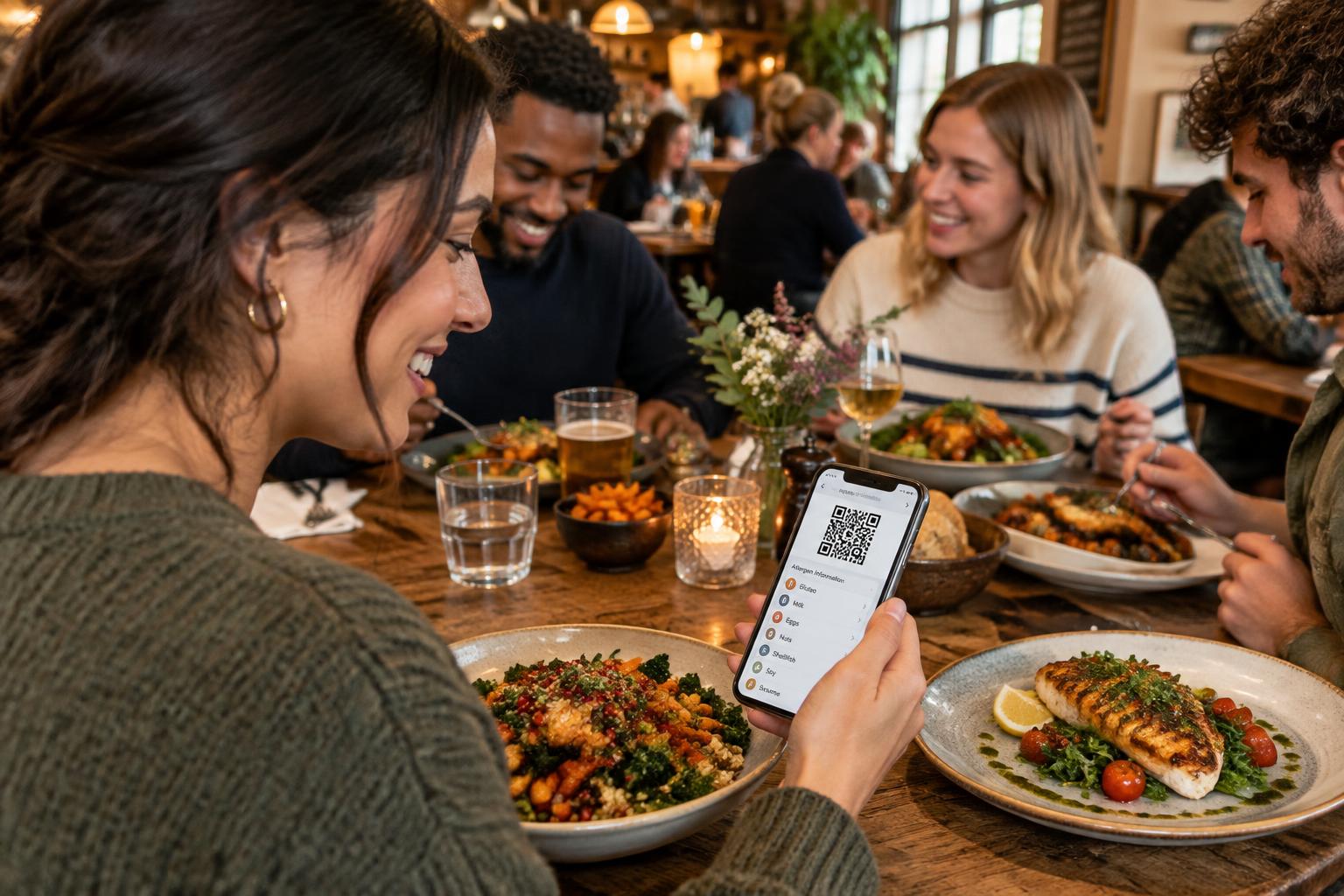
Most food businesses think about allergens as a legal job: get it right, stay out of trouble. That matters. But there is another side to it. An allergy friendly restaurant is also a busier restaurant, because people with allergies, intolerances and coeliac disease are a large group of diners who pick carefully, plan ahead and come back to places they trust.
This guide looks at the UK data on allergy diners, what makes them choose one venue over another, and simple ways to turn your allergen information into a reason to visit.
How many of your customers have food allergies or intolerances?
More than you might think. In the Food Standards Agency's latest Food and You 2 survey, 23% of respondents reported having a food hypersensitivity, meaning a food allergy, intolerance or coeliac disease (FSA, Food and You 2 Wave 11, published 31 March 2026).
Separate FSA research estimates that around 6% of UK adults, about 2.4 million people, have a clinically confirmed food allergy, and more than 30% reported some kind of adverse reaction to food (FSA, May 2024).
And it reaches further than the person with the allergy. In a January 2024 YouGov survey of 2,134 adults in Great Britain, 32% had a food allergy or knew someone close to them who did (High Speed Training, Food Allergens Report 2024).
Put simply: on a busy Saturday, a real share of the people deciding where to eat are thinking about allergens.
The veto vote: one diner decides where the group eats
When friends, families or colleagues go out together, the person with the allergy often decides where everyone goes. If they are not confident a venue can feed them safely, the whole table goes somewhere else.
Research backs this up. A 2025 study of 1,500 consumers found that food allergies influenced where people ate for 44% of participants without food allergies, when they were dining with people outside their household (Nutrients, September 2025). That study was carried out in Canada, so treat it as a strong signal rather than a UK figure, but the pattern will feel familiar to anyone who has organised a group booking.
The same study found that diners with food allergies were noticeably more loyal to restaurants than other diners. Once they find somewhere they feel safe, they tend to stick with it.
Picture a Friday night. Six colleagues are choosing somewhere for after-work food, and one of them has a sesame allergy. They open two pub websites. One has a clear allergen menu they can filter in seconds. The other says "please ask staff". The group books the first pub, and if the evening goes well, that is where they go next time too.
For an independent restaurant, café or pub, that is the opportunity. Win the trust of one allergy diner and you can win their whole group, again and again.
Allergy diners check before they choose
People with food hypersensitivities do their homework. A UK study of 930 adults with food hypersensitivity found the following (Knibb et al., Clinical and Translational Allergy, 2024):
- Check information before deciding where to eat – 79% do this always or most of the time
- Check available information before ordering – 84%
- Ask staff for information before ordering – 74%
Allergy UK gives its community the same advice: research the menu on the venue's website first, and phone ahead to talk through options if needed (Allergy UK, Eating out).
So your allergen information is part of how customers choose you, before they ever walk through the door. If it is hard to find, out of date or missing, many of them will simply book elsewhere.
What makes allergy diners trust a venue
The same UK study found a clear gap in confidence. 62% of adults with food hypersensitivity were very or fairly confident in written allergen information, but only 43% felt the same about verbal information (Knibb et al., 2024).
Asking is not always easy either. In the FSA's Food and You 2 survey, 71% of respondents said they felt comfortable asking staff for more allergy information when eating out (FSA, Food and You 2 Wave 11). That leaves a sizeable minority who do not.
Younger diners can be especially wary. In a 2023 survey of more than 800 mostly 16 to 25 year olds, run by Serve Legal with Anaphylaxis UK, 60% of those with allergies or dietary requirements had avoided eating out because of them, and 45% felt treated as an inconvenience when ordering (Anaphylaxis UK).
Putting that together, allergy diners tend to trust venues that:
- Show allergen information in writing, clearly, for every dish
- Make it easy to find before they visit, not just on request
- Keep it up to date, including specials
- Have staff who are happy to talk about allergies and never make customers feel awkward
- Are open about what they cannot guarantee, such as cross-contact in a shared kitchen
Allergy friendly does not mean allergen free
Some owners worry that calling themselves allergy friendly means promising food that is completely free of allergens. It does not. Most small kitchens handle flour, nuts, milk and eggs every day, and allergy diners know that.
What they want is honesty. Tell them what is in each dish, tell them where cross-contact is possible, and let them make an informed choice. A line such as "We handle all 14 allergens in our kitchen, so we cannot guarantee any dish is completely allergen free, but please ask and we will help you choose" builds far more trust than a vague promise.
Be careful with "free from" claims too. Only describe a dish as free from an allergen if you have controls in place to back that up. If in doubt, list the allergens and explain the risk instead. Our guide on how to write an allergy menu covers the wording in more detail.
Turning allergen information into a marketing asset
Here is the good news: if you already record your allergens properly, you have most of what you need. The trick is to make it visible. Our guide on how to create an allergen-friendly menu covers the menu itself. Below is how to put it to work.
Put your allergen menu on your Google Business Profile. Plenty of diners look up places nearby on Google before choosing. Add a link to your allergen menu in your profile, and mention it in your description, for example "Full allergen menu online, covering all 14 allergens."
Link it from your website and booking page. Put a clear "Allergen menu" link on your homepage, menu page and booking confirmation. Allergy diners are already looking for it, so do not make them dig.
Share it on social media. A short post showing customers how to check dishes for their allergens tells everyone, including the friends of allergy diners, that you take it seriously. Pin it to the top of your profile.
Put a QR code where people decide. A QR code on your window, A-board, tables and till lets passers-by and seated customers check dishes in seconds. With Allergenius, customers scan the code and filter the whole menu by their allergens, with no app needed.
Train your team to welcome the question. Written information builds trust, but a friendly conversation keeps it. Make sure every team member knows where the information is and how to respond. Our allergen training for staff guide covers what to teach.
Quick wins you can do this week
- Check every dish, sauce and side against the 14 UK allergens
- Make sure specials and seasonal dishes are included
- Add an "Allergen menu" link to your website and Google Business Profile
- Put a QR code for your allergen menu on the window and tables
- Add a line to your menu: "Please tell us about any allergies, we are happy to help"
- Brief your team on where allergen information lives and how to answer questions
- Post once on social media showing how customers can check allergens
If your allergen information still lives in a paper folder behind the counter, it is invisible to the customers deciding where to go. Our guide to switching from paper allergen folders to digital menus walks through the move step by step.
Do this and it pays back
Being an allergy friendly restaurant does not mean changing your food. It means making it easy for allergy diners to see, before they arrive, that they will be looked after. The UK data shows they check first, they trust written information more than verbal, and they bring friends and family with them. Clear, findable allergen information is one of the simplest ways to turn that into more covers.
Make your allergen info findable online
Allergenius gives every dish written allergen information across all 14 allergens, on a QR code and a shareable link you can put on Google, your website and social media. Customers filter the menu by their allergens in seconds, and when you change a dish, it updates instantly everywhere.
See the demo menu to see what your customers would see, then sign up here. Plans start from £9 a month, or we can set it all up for you for a one-off £125.
Frequently Asked Questions
Ready to Simplify Allergen Management?
If you're looking for a solution to display your allergens to your customers, Allergenius makes it easy with digital menus and QR codes.
Get the free allergen matrix (PDF + editable Excel)
Enter your details and we'll email you both versions – the printable PDF for the kitchen wall, and the fill-in Excel version for your computer.
We'll email your download link straight away. A member of our team may be in touch to see how you're getting on. See our privacy policy.