Vegan menu allergens: why vegan is not the same as allergen free
Many independent cafes, pubs and restaurants now have a vegan section on the menu. That creates a quiet risk that catches out even careful kitchens: treating “vegan” as if it means “safe for allergies”. Getting your vegan menu allergens right means understanding that a vegan label tells customers what is not in a dish by choice, not what is safe for them to eat.
This guide explains why vegan is not a safety claim, which of the 14 allergens most often hide in plant-based food, and how to label vegan dishes so customers with allergies get accurate information.
Latest update (3rd November 2026)
- Law now: If you sell non-prepacked food (dishes made and served on site), you must give customers information about any of the 14 allergens your food contains. UK law still allows this information to be given verbally.
- Proposed, not law: Owen’s Law, the campaign for written allergen information on restaurant menus, had not been enacted as of September 2026, according to a Leigh Day blog post from 1st October 2026. It is supported in principle by the Food Standards Agency (FSA).
- Best practice now: The FSA’s best-practice guidance for non-prepacked food says businesses should make allergen information easily available in writing and ask every customer about allergen needs. This guidance is voluntary, not law.
- Vegan labels: There is still no legal definition of “vegan” in UK law.
Why “vegan” is not an allergy safety claim
A vegan label describes a dietary choice. It tells customers that a dish has no ingredients of animal origin on purpose. It does not promise that the dish is free from any allergen, and it says nothing about the plant-based allergens it may contain.
The FSA is clear on this. When it launched its vegan food and allergens campaign in March 2024, it explained that a “free from” label is a food safety label, while a vegan label is not. Vegan food may be prepared alongside milk, egg, fish, or crustaceans and molluscs. Free-from food should not be.
Many customers do not know this. The FSA’s own research, carried out by Ipsos in December 2023, found that 62% of people who react to animal-based allergens, or shop for someone who does, were confident that products labelled “vegan” are safe for them to eat. The FSA says that belief is incorrect. The same research found that 45% of people with a food hypersensitivity to animal-origin allergens used vegan labelling to judge whether non-packaged food was safe, at least some of the time.
That last figure matters for restaurants and cafes. Non-packaged food is exactly what you serve. Some customers with a milk or egg allergy will see “Vegan” on your menu and assume they are fine without asking.
There is no legal definition of vegan
UK law does not define “vegan”. The Food and Drink Federation’s guidance on allergen-free and vegan claims confirms there is no legal definition in UK or EU law, although general food law still requires food to be safe and labelling not to mislead. Natasha’s Allergy Research Foundation adds that there is no set limit on how much animal-derived material a vegan product can contain through cross-contamination.
Even the Vegan Trademark is not an allergy standard. The Vegan Society says its checks “do not address products to an allergen standard” and that vegan claims “should not be considered automatically safe for people with food allergies”.
Vegan, dairy free and milk free are not the same
These words get mixed up on menus all the time. Here is the difference in plain terms:
| Term | What it tells the customer | Is it a safety claim? |
|---|---|---|
| Vegan | No animal ingredients used on purpose | No |
| Plant based | Made mainly or wholly from plants | No |
| Dairy free | No dairy ingredients used on purpose. May still contain egg | Only if backed by strict controls. “Milk free” is clearer |
| Free from (a named allergen) | The named allergen is absent, backed by strict controls | Yes |
| May contain (a named allergen) | There is a real risk of cross-contact | Warning, not a claim |
The FDF guidance points out that “dairy free” does not guarantee “milk free”, and that a vague “allergen free” claim that does not name the allergen should be treated as misleading.
The allergens hiding in vegan dishes
Vegan cooking leans heavily on ingredients that are on the list of 14 allergens. If you need a refresher, see our guide to the 14 food allergens in the UK. These are the ones to watch most closely on a plant-based menu.
Soya
Tofu, tempeh, edamame, miso, soy sauce, soya milk and many meat alternatives are all soya. It also turns up in vegan mayonnaise, spreads, cheese alternatives and chocolate. It is easy to miss in a bought-in sauce or marinade.
Nuts and peanuts
Cashew-based cheeses and creams, almond milk, nut butters, pesto, nut roasts, energy balls and many vegan cakes rely on nuts. Peanuts appear in satay sauces, some curries and snack bars. Remember that peanuts and tree nuts are listed separately among the 14 allergens, so you need to declare them separately.
Sesame
Tahini is the base of hummus and many dressings. Sesame seeds and sesame oil are common in Asian-style vegan bowls, falafel wraps and seeded breads. A single drizzle of dressing can turn a “simple salad” into a sesame dish.
Cereals containing gluten
Seitan is made from wheat gluten, so it is almost pure gluten. Wheat also hides in vegan sausages, burgers, batters, breadcrumbs, soy sauce and stock cubes. Vegan is not the same as gluten free, and coeliac customers will need clear information either way.
Lupin
Lupin is a legume, like peanuts and soya. Anaphylaxis UK notes that some vegan products use lupin in place of milk, and that lupin flour can appear in pasta, baked goods, breadcrumbs and some gluten-free products. Some people with a peanut allergy are also allergic to lupin, so it is worth knowing which of your bought-in ingredients contain it.
Mustard, celery and sulphites
Mustard is common in vegan mayonnaise, dressings and marinades. Celery turns up in stocks, soups and vegetable bases. Sulphites can be found in dried fruit, some vinegars and wine used in cooking.
Animal-origin allergens through cross-contact
Even with no animal ingredients, a vegan dish can pick up milk, egg, fish or crustaceans from shared kit. A vegan burger cooked on the same griddle as a cheese-topped beef burger, chips from a fryer that also cooks battered fish, or a vegan cake cut with the same knife as a cream cake can all carry traces.
Quick reference: common vegan dishes and their allergens
Use this table as a starting point, then check your own recipes and every ingredient label. Recipes and suppliers vary, so your allergen matrix must always reflect what you actually use.
| Dish or ingredient | Allergens it often contains |
|---|---|
| Tofu stir fry with soy sauce | Soya, cereals containing gluten (wheat in soy sauce), sometimes sesame |
| Hummus and falafel wrap | Sesame (tahini), cereals containing gluten (wrap), sometimes mustard |
| Cashew cheese or cream | Tree nuts |
| Seitan “steak” or kebab | Cereals containing gluten |
| Satay noodles | Peanuts, soya, cereals containing gluten |
| Vegan mayonnaise | Soya, mustard |
| Vegan sausage or burger | Soya, cereals containing gluten, sometimes mustard or celery |
| Vegan cakes and brownies | Cereals containing gluten, soya, sometimes nuts |
| Vegetable soup made with stock | Celery, sometimes cereals containing gluten |
| Oat milk latte | Cereals containing gluten (oats can be cross-contaminated with wheat; check the label) |
If you have not built an allergen matrix yet, our free allergen matrix template is a good place to start.
How to label vegan dishes on your menu
The goal is simple: a customer should be able to see, for every vegan dish, which of the 14 allergens it contains, and whether there is a risk of cross-contact. Here is how to get there.
1. Treat vegan dishes like every other dish
Every vegan dish needs the same full allergen check as the rest of your menu. Do not skip a dish because it “has no dairy or egg”. Check every ingredient, including sauces, oils, dressings, garnishes and anything bought in. Our guide on how to write an allergy menu walks through the process step by step.
2. Keep the vegan symbol and the allergen information separate
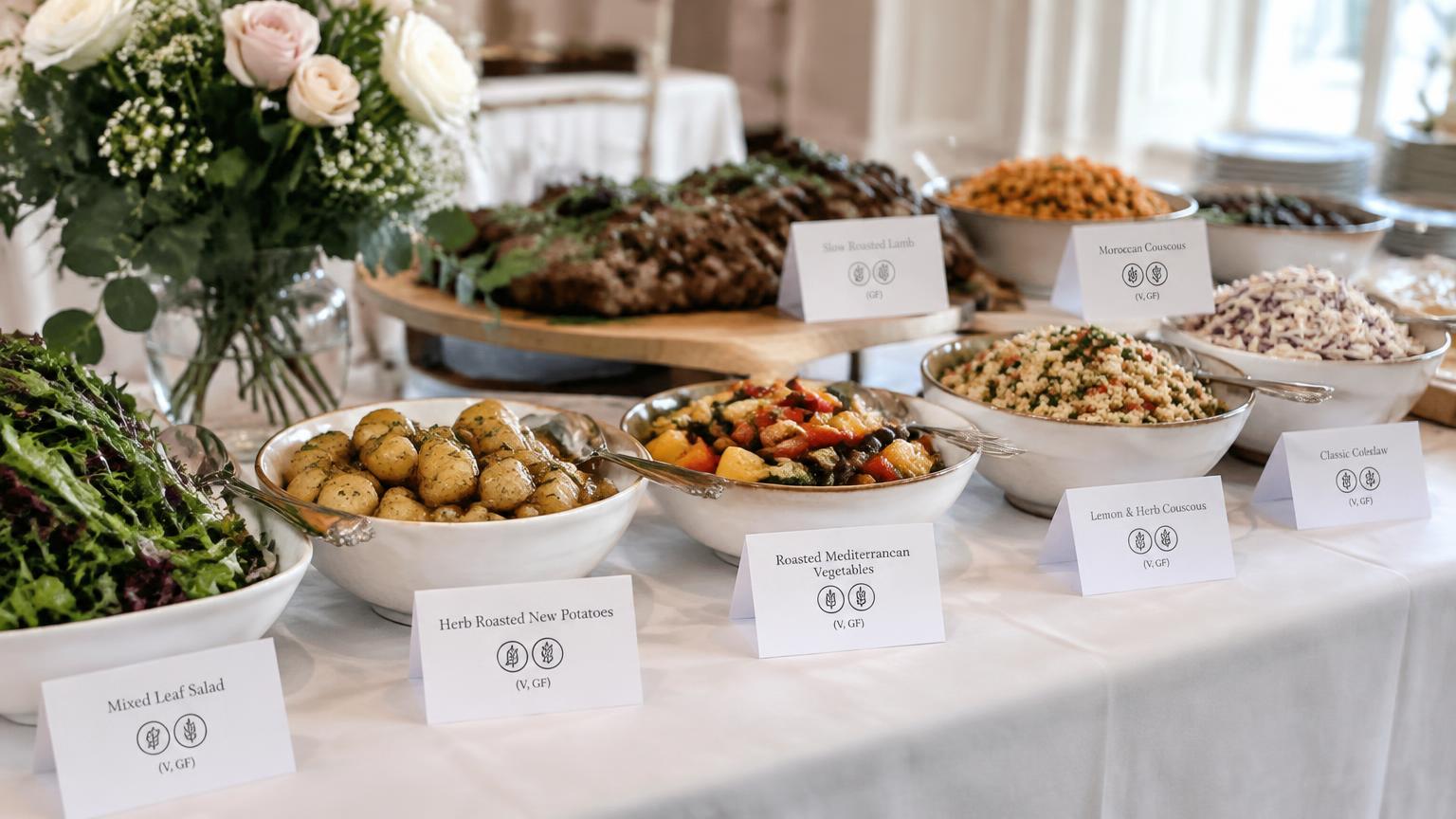
A “V” or “VG” symbol is a dietary label. Show allergens separately and clearly, by naming each of the 14 allergens a dish contains. The FSA best-practice guidance says written allergen information should cover all 14 allergens, not a selection, and that free-from claims and allergen information should be clearly distinguished.
3. Be honest about cross-contact
If your vegan dishes are cooked in a kitchen that also handles milk, egg, fish or nuts, and you cannot rule out cross-contact, say so. The FSA’s technical guidance advises using a precautionary allergen label alongside a vegan label where cross-contamination cannot be ruled out. Only use “may contain” after a real risk assessment, not as a blanket disclaimer. Our guide to may contain warnings and precautionary allergen labelling explains how to do this well.
The FSA’s non-prepacked best-practice guidance gives an example of kitchen-wide wording: “We use peanuts, nuts, soy and wheat (gluten) in our kitchen, please speak to us so we can prepare your meal safely.”
4. Do not call vegan dishes “allergen free” or “dairy free” unless you can prove it
If a customer with a severe milk allergy reads “dairy free”, they may stop asking questions. Only make a free-from claim for a named allergen if you have strict controls to back it up.
5. Train staff to answer the vegan question properly
When a customer asks “Is this vegan?”, staff should also ask “Do you have any allergies we should know about?”. The FSA best-practice guidance says businesses should ask all customers whether they have any allergen requirements. Staff need to understand that a vegan customer and a milk-allergic customer have different needs, even if they order the same dish. Our allergen training guide for staff covers what your team needs to know.
Kitchen checklist for vegan menu allergens
Run through this checklist whenever you add or change a vegan dish:
- Every ingredient in the dish (including sauces, oils and garnishes) checked against the 14 allergens
- Bought-in products checked for soya, nuts, sesame, gluten, lupin, mustard and celery
- Supplier labels checked again when a product or brand changes
- Allergens listed separately from the vegan symbol on the menu
- Shared fryers, griddles, blenders and utensils identified
- Cross-contact risk assessed and, where real, a clear “may contain” or kitchen statement added
- No “allergen free” or “dairy free” claims without strict controls
- Staff trained to ask about allergies, not just dietary preferences
- Allergen matrix and menu updated on the same day as any recipe change
Keeping vegan allergen information accurate
Plant-based menus change often. Suppliers swap brands and specials rotate, and each change can bring in a new allergen that a paper folder will miss.
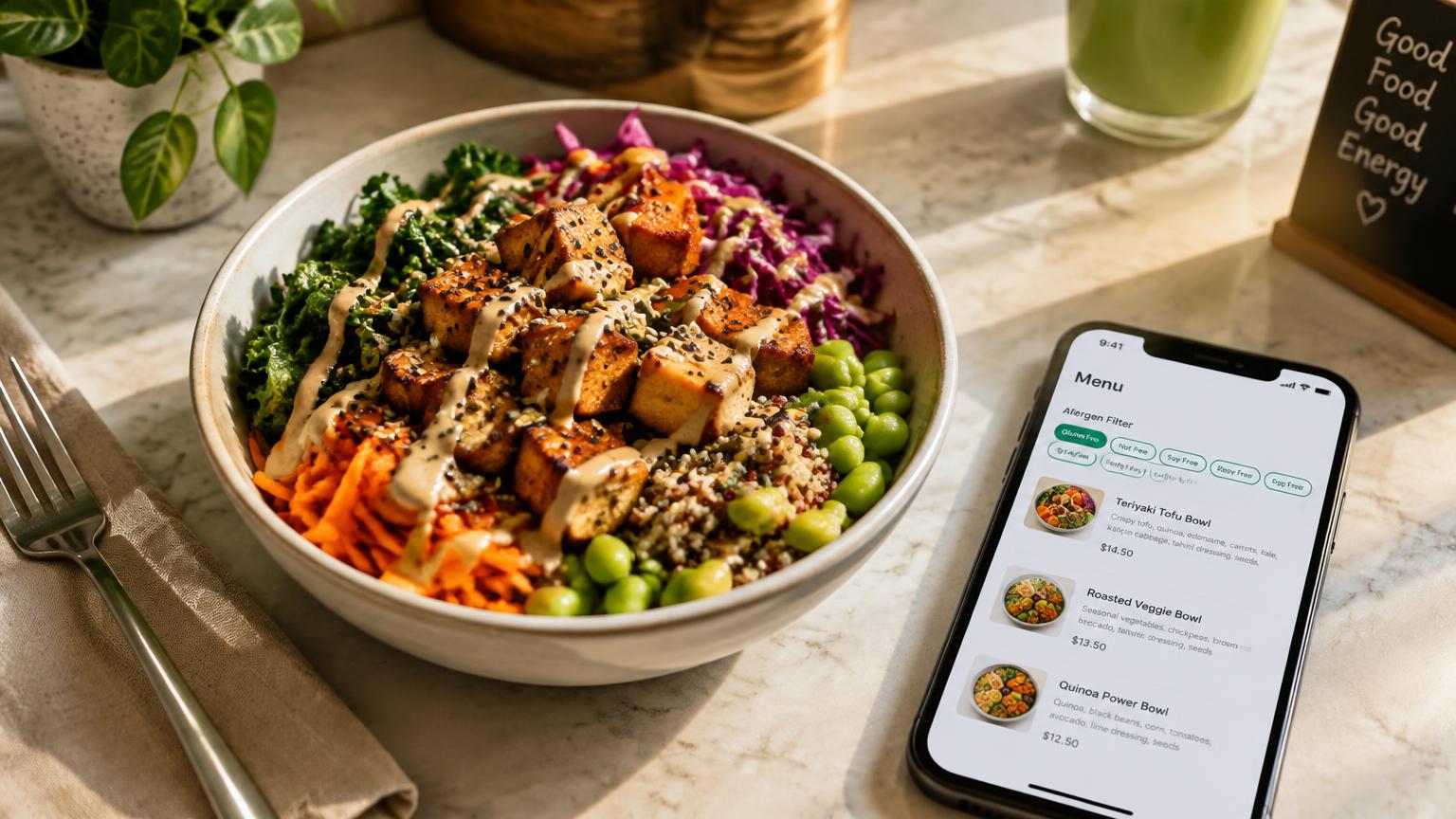
This is where a digital allergen menu helps. With Allergenius, you add each dish once with its allergens across all 14, and customers scan a QR code to see the full allergen information for every dish, with no app needed. Customers can filter the menu by their own allergens, so someone avoiding soya or sesame can quickly see which vegan dishes suit them. When you change a recipe or swap a supplier, you update the dish and the change goes live straight away, so your printed QR code never goes out of date.
It is worth being clear about what a digital menu does and does not do. It helps you give customers accurate written allergen information, and it gives staff a reliable place to check. It does not replace your kitchen controls, your risk assessment or the conversation with the customer. Use it alongside them.
The bottom line
“Vegan” is a dietary label, not an allergy safety label. Check every vegan dish against the 14 allergens, show allergens separately from the vegan symbol, be honest about cross-contact and train your team to ask about allergies every time.
See how it works: take a look at the Allergenius demo menu to see how customers filter dishes by allergen. When you are ready, sign up and build your own allergen menu, with plans for every size of business on our pricing page.
Frequently asked questions
Is vegan food allergen free?
No. Vegan means a dish has no ingredients of animal origin on purpose. It can still contain plant-based allergens such as soya, nuts, peanuts, sesame, cereals containing gluten, lupin, mustard and celery. It can also pick up milk, egg, fish or crustaceans through cross-contact in a shared kitchen.
Is vegan food safe for someone with a milk allergy?
Not automatically. The FSA warns that vegan food may be prepared alongside milk and egg, so traces can be present. Customers with a milk allergy should always ask, and businesses should give clear information about any cross-contact risk.
Is there a legal definition of vegan in the UK?
No. There is no legal definition of “vegan” in UK law. General food law still requires food to be safe and labelling not to mislead customers.
What allergens are most common in vegan dishes?
Soya (tofu, tempeh, soy sauce, meat alternatives), tree nuts and peanuts (nut cheeses, satay, pesto), sesame (tahini, hummus, dressings) and cereals containing gluten (seitan, wraps, batters) are the most common. Lupin, mustard and celery also appear in many plant-based products.
Do I have to list allergens in writing on my vegan menu?
For non-prepacked food, the law requires you to provide information on any of the 14 allergens in your food, and this can currently be given verbally. Written allergen information is FSA best practice, and Owen’s Law, which would make it a requirement for restaurant menus, is proposed but not yet law.
Can I describe my vegan dishes as dairy free?
Only if you are confident there is no milk in the dish and you have controls to prevent cross-contact. “Dairy free” can still contain egg, and the FDF says “milk free” is clearer. If you cannot rule out cross-contact, do not make the claim.
Ready to Simplify Allergen Management?
If you're looking for a solution to display your allergens to your customers, Allergenius makes it easy with digital menus and QR codes.
Get the free allergen matrix (PDF + editable Excel)
Enter your details and we'll email you both versions – the printable PDF for the kitchen wall, and the fill-in Excel version for your computer.
We'll email your download link straight away. A member of our team may be in touch to see how you're getting on. See our privacy policy.